S455 Tax: What It Is, When It Applies and How to Reclaim It
What is S455 tax?
Section 455 of the Corporation Tax Act 2010 imposes a Corporation Tax charge on close companies that make loans to participators — typically director-shareholders — and those loans remain outstanding past a specific deadline.
The charge exists because without it, a director could indefinitely borrow money from their company without paying any tax on it. An employee who received the same money would pay Income Tax and National Insurance. S455 prevents the company structure from being used to extract value tax-free through a permanent loan.
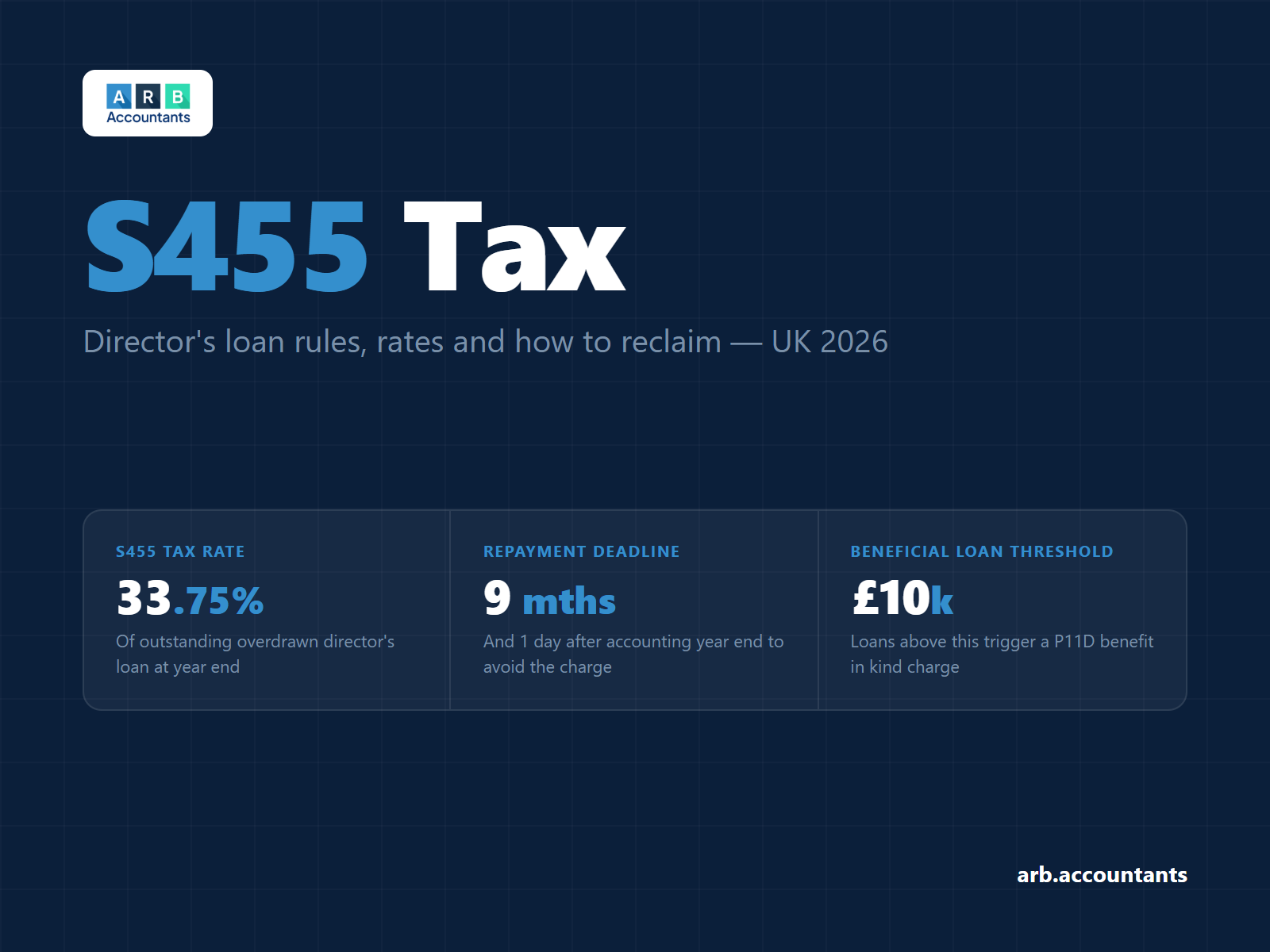
The tax is not a penalty for doing something wrong. It is a holding charge — a deposit HMRC collects to ensure the loan is eventually dealt with. Once the loan is repaid, S455 can be reclaimed in full. The practical consequence is a significant cash flow impact: you pay 33.75% of the outstanding loan to HMRC and wait up to nine months after repayment before getting it back.
When does S455 tax apply?
S455 applies when three conditions are met simultaneously:
1. The company is a close company. Most owner-managed limited companies are close companies. A company is close if it is controlled by five or fewer participators, or by any number of participators who are directors. If you own and run your own limited company, it is almost certainly a close company.
2. A loan has been made to a participator. A participator is broadly a shareholder or someone with an interest in the company’s income or capital. Director-shareholders are participators. The loan includes any overdrawn balance on the director’s loan account — money taken from the company that is not salary, dividend or reimbursement of a business expense.
3. The loan is outstanding nine months and one day after the year end. The trigger is not the date the loan was taken — it is the state of the account at the company’s accounting year end, and whether it remains unpaid nine months and one day later. A loan taken in January, repaid in March, and the year end is December — no S455 arises because the account is clear at year end.
The key date formula:
| Year end | S455 payment deadline |
|---|---|
| 31 March | 1 January (following year) |
| 30 June | 1 April (following year) |
| 30 September | 1 July (following year) |
| 31 December | 1 October (following year) |
S455 tax rate
The S455 tax rate is 33.75% of the outstanding overdrawn loan balance.
This rate has applied since April 2022. Before that date the rate was 32.5%. The rate is set deliberately to mirror the higher rate of dividend tax (also 33.75%), because the loan is economically similar to an undeclared dividend — the director is extracting value from the company without paying the tax that would apply to a dividend.
Example:
A director’s loan account is overdrawn by £40,000 at the company’s 31 March year end. The loan is not repaid by 1 January (the nine-month deadline).
S455 tax due: £40,000 x 33.75% = £13,500
This is payable to HMRC alongside the company’s Corporation Tax. It sits alongside, not inside, the Corporation Tax calculation — it is an additional charge on top of any Corporation Tax owed on profits.
When is S455 tax due?
S455 tax is due on the same date as the company’s Corporation Tax payment: nine months and one day after the accounting year end.
This aligns with the repayment deadline. The logic is: if you have not repaid the loan by the date Corporation Tax is due, HMRC collects the S455 charge at that point.
For companies with profits above £1.5m that pay Corporation Tax in instalments, S455 is still due at the nine-month date, not through the instalment arrangement.
The charge is reported on the company’s CT600 Corporation Tax return, specifically on the supplementary pages CT600A. If you use an accountant, they will include the S455 calculation in your annual accounts and CT600 filing.
How to avoid S455 tax
Option 1: Repay the loan before the nine-month deadline. The most straightforward approach. Transfer cash from your personal account to the company account before the deadline. The overdrawn balance clears and no S455 arises. Keep a clear record of the transfer date.
Option 2: Vote a dividend to clear the account. If your company has sufficient distributable reserves (retained profits), you can declare a dividend equal to the overdrawn balance. The dividend clears your loan account — you owe the company the loan, and the company owes you the dividend; they cancel out. The dividend is subject to dividend tax in your personal tax return but avoids S455 at the company level. This only works if there are genuine profits available. You cannot declare a dividend that exceeds distributable reserves.
Option 3: Pay yourself a bonus. A salary or bonus payment creates PAYE income, reduces company profits and credits your loan account. This clears the overdrawn balance but triggers Income Tax and National Insurance on the bonus — often a worse outcome than simply repaying from personal funds.
Option 4: Avoid the situation in the first place. Review your director’s loan account at regular intervals during the year, not just at year end. Many directors inadvertently build up overdrawn balances through ad hoc drawings that are not properly coded as salary or dividends. Regular bookkeeping reviews catch this before it becomes a nine-month countdown problem.
How to reclaim S455 tax
If S455 tax has already been paid, you can reclaim it under Section 458 CTA 2010 once the underlying loan is repaid, written off or released by the company.
The reclaim delay. The reclaim is not immediate. It becomes available nine months and one day after the end of the accounting period in which the loan repayment took place. This means there are two nine-month waits: one before S455 is charged, and another after repayment before the reclaim lands.
How the timing works in practice:
A company has a 31 March year end. The DLA is overdrawn at 31 March 2025. S455 of £10,125 is paid on 1 January 2026 (nine months after 31 March 2025). The director repays the loan in full on 1 August 2026 — within the accounting year ending 31 March 2027. The S455 reclaim becomes available on 1 January 2028 (nine months after 31 March 2027).
Total cash tied up with HMRC: from 1 January 2026 to 1 January 2028 — two full years.
How to submit the reclaim. You can reclaim S455 tax using:
- Form L2P — submitted directly to HMRC once the nine-month waiting period has passed. HMRC typically processes L2P claims within 30 days and refunds directly to the company’s bank account.
- CT600A — include the reclaim in the company’s Corporation Tax return for the period containing the repayment. HMRC offsets the refund against any outstanding Corporation Tax liability or issues a direct repayment.
If you use an accountant to prepare your accounts and CT600, flag the loan repayment date to them so the reclaim is included at the earliest opportunity.
The bed and breakfasting rules — anti-avoidance
HMRC is aware that directors might repay a loan just before the year end to escape S455, then immediately re-borrow. Two anti-avoidance rules prevent this.
The 30-day rule. If a loan is repaid within 30 days before or after the year end and the director re-borrows more than £5,000 within 30 days of that repayment, HMRC treats the repayment as if it never happened. The S455 charge still applies as if the loan were outstanding.
The arrangements rule. Even outside the 30-day window, if a repayment and re-borrowing form part of a pre-planned arrangement to avoid S455, HMRC can apply broader anti-avoidance provisions. The test is whether there was an intention at the time of repayment to re-borrow.
In practice, this means genuine repayments — where the director has actually cleared the debt using their own funds and has no plan to immediately take the money back — are safe. It is the “repay, escape S455, re-borrow the same money” pattern that the rules target.
S455 and the beneficial loan charge
When a director’s loan account exceeds £10,000 at any point during the tax year and the company charges no interest (or interest below HMRC’s official rate), a separate benefit in kind arises. This is the beneficial loan charge and is separate from S455.
The benefit in kind is calculated as interest at HMRC’s official rate (currently 2.25% for 2024/25) on the average overdrawn balance during the year. It is reportable on a P11D form (or through payrolled benefits from April 2026) and subject to Income Tax in the director’s personal Self Assessment return. The company also pays Class 1A National Insurance at 13.8% on the benefit.
A director with a £50,000 overdrawn DLA for the full year would have a beneficial loan benefit of approximately £1,125 (£50,000 x 2.25%). Their personal tax liability on this depends on their marginal rate.
S455 and the beneficial loan charge can both apply to the same loan simultaneously — they are calculated and reported separately.
S455 on loans to associates — Section 464A
The S455 rules extend beyond the director personally. Section 464A CTA 2010 applies the same charge to loans made to associates of participators. Associates include:
- Spouse or civil partner
- Minor children and their spouses
- Business partners
- Trustees of a settlement in which the participator has an interest
If a close company lends money to a director’s spouse or their adult child’s company, the S455-equivalent charge under S464A applies in exactly the same way, at the same 33.75% rate, with the same nine-month repayment window.
Writing off the loan — usually not the answer
When a loan cannot be repaid, directors sometimes ask whether writing it off avoids S455. The answer is that write-off does not avoid tax — it just moves the problem.
When a company writes off a director’s loan:
- The amount written off becomes employment income for the director, subject to Income Tax and Class 1 National Insurance
- The company loses the ability to reclaim any S455 tax already paid under S458 relief
- The company may lose the Corporation Tax deduction (write-offs are not generally deductible)
In most cases, repaying the loan and reclaiming S455 is significantly more tax-efficient than writing it off. The exception is where the director genuinely cannot repay and has no other way to clear the balance — in that case, the write-off formalises the position and allows the company’s accounts to reflect reality.
Frequently asked questions
What is S455 tax?
A Corporation Tax charge under Section 455 CTA 2010 on overdrawn director’s loans in close companies that are not repaid within nine months and one day of the accounting year end. The rate is 33.75%.
What is the S455 tax rate?
33.75% of the outstanding overdrawn loan balance at the company’s year end. This rate has applied since April 2022, increased from the previous 32.5%, and mirrors the higher rate of dividend tax.
When does S455 tax apply?
When a close company has an outstanding loan to a director-shareholder that remains overdrawn nine months and one day after the accounting year end. The charge is assessed on the year-end balance.
When is S455 tax due?
Nine months and one day after the company’s accounting year end — the same date Corporation Tax is due. Reported on the CT600A supplementary pages.
How do I reclaim S455 tax?
Once the loan is repaid, submit form L2P to HMRC or include the reclaim on your CT600A. The reclaim becomes available nine months and one day after the end of the accounting period in which repayment took place — not immediately on repayment.
How long does the S455 reclaim take?
HMRC processes L2P claims in approximately 30 days. But you cannot submit until nine months and one day after the year end in which repayment occurred, so the total wait from paying S455 to receiving the refund can be close to two years.
Can I avoid S455 by voting a dividend?
Yes, if your company has sufficient distributable profits. Declare a dividend equal to the overdrawn balance before or at the year end. The dividend clears the loan account and avoids S455, though the dividend is subject to dividend tax in your personal return.
What are the bed and breakfasting rules?
Anti-avoidance rules that prevent repaying a loan close to year end and immediately re-borrowing. If a loan is repaid within 30 days of the year end and re-borrowed above £5,000 within 30 days, HMRC treats the repayment as if it never happened and charges S455 anyway.
Does S455 apply to loans to a director’s family?
Yes. Section 464A CTA 2010 applies the same charge to loans to associates of participators — including spouses, civil partners and minor children — at the same 33.75% rate with the same nine-month deadline.
Get Expert Help With Director’s Loan Account Tax
S455 tax is avoidable with the right planning, but the timing rules and reclaim process are easy to get wrong. ARB Accountants advises company directors on DLA management, S455 exposure and the most tax-efficient way to resolve overdrawn accounts before deadlines hit.
ACCA-chartered. Fixed fees. Free 60-minute consultation.
Book a free consultation or call 01702 345 207.
Frequently Asked Questions
What is S455 tax?
S455 tax is a Corporation Tax charge under Section 455 of the Corporation Tax Act 2010. It applies when a close company — typically an owner-managed limited company — has an outstanding loan to a participator (usually a director-shareholder) that is still overdrawn nine months and one day after the company's accounting year end. The charge is 33.75% of the outstanding balance and is due alongside the company's Corporation Tax payment.
What is the S455 tax rate?
The S455 tax rate is 33.75% of the outstanding overdrawn director's loan balance. This rate has applied since April 2022, when it was increased from 32.5% to align with the higher rate of dividend tax. The rate applies to the full overdrawn balance at the company's accounting year end that remains unpaid after the nine-month window.
When does S455 tax apply?
S455 tax applies when three conditions are met: the company is a close company, a loan has been made to a participator (director-shareholder), and the loan remains outstanding nine months and one day after the end of the accounting period in which it was made. It is assessed on the overdrawn balance at the year end, not the highest balance during the year.
When is S455 tax due?
S455 tax is due on the same date as the company's Corporation Tax payment — nine months and one day after the accounting year end. For a company with a 31 March year end, S455 is due on 1 January the following year. It is reported on the CT600 return alongside Corporation Tax and must be paid to HMRC by the same deadline.
How do I reclaim S455 tax?
You can reclaim S455 tax once the director's loan has been repaid, written off or released. However, the reclaim does not become available immediately. It becomes claimable nine months and one day after the end of the accounting period in which the loan was repaid. Submit the reclaim on form L2P or via the CT600A of your later Corporation Tax return. HMRC will refund the S455 tax previously paid.
How long does it take to reclaim S455 tax?
The reclaim process adds a delay on top of the repayment. If a director's loan was overdrawn in the year ending 31 March 2025 and you paid the S455 charge, then repaid the loan in the year ending 31 March 2026, the reclaim does not become available until 1 January 2027 — nine months and one day after 31 March 2026. HMRC processes L2P repayment claims within about 30 days of receipt.
Can I avoid S455 tax by voting a dividend?
Yes, if your company has sufficient distributable profits. Voting a dividend before the year end to clear the overdrawn loan account is a legitimate and common approach. The dividend must be properly declared with a board minute and dividend voucher, and you must have the retained profits to support it. If profits are insufficient, a dividend cannot cover the full loan and you may still face a partial S455 charge.
What are the bed and breakfasting rules for S455 tax?
HMRC's bed and breakfasting rules prevent directors from repaying a loan just before the year end to avoid S455 and then immediately re-borrowing. If a loan is repaid within 30 days before or after the year end and a new loan of more than £5,000 is taken out within 30 days of that repayment, HMRC treats the repayment as not having happened and the S455 charge still applies. Broader anti-avoidance provisions also apply to arrangements designed to avoid S455 over longer periods.
Does S455 tax apply to write-offs?
S455 tax can also be triggered when a company writes off a director's loan rather than receiving repayment. Writing off the loan means the director receives taxable income equal to the amount written off — subject to Income Tax and National Insurance — and the company loses the benefit of reclaiming any S455 tax already paid under S458 relief. Writing off a loan is rarely more tax-efficient than repaying it.
Does S455 apply to loans to family members of directors?
Yes. Section 464A CTA 2010 extends a similar charge to loans made to associates of participators — which includes spouses, civil partners, children and other connected persons. The rules and rates mirror S455. A loan from a close company to a director's spouse or adult child is subject to the same nine-month repayment window and 33.75% charge.
About The Author

Saurabh Bedi | Director
Saurabh is a tax advisor at ARB Accountants, specialising in Self-Assessment and small business tax. He's dedicated to making tax simple and stress-free, helping clients stay compliant and confident with HMRC.
Qualifications & Experience
- Fellow of Chartered Certified Accountants (ACCA)
- MSc Chartered Certified Accountancy 2008
- Working in accountancy since 2008